

 Cart is empty
 Which pool cover or blanket would you suggest?
If you’re looking for my recommendation on the type of blanket, I’d suggest going for a 525 micron if possible, as they tend to have a much longer lifespan. As for the color, that’s entirely up to you. Daisy offers a warranty of 8 years (or 10 if they handle the installation). All blankets come with a pro-rata warranty.
Should I add extra measurements to account for the upturn when measuring for a pool cover?
No, Daisy will add a minimum of 15 cm (150 mm) to the width and 30 cm (300 mm) to the length to account for shrinkage and upturn, so you only need to provide the inline water measurements.
Do all pool covers help heat the pool?
All of them are solar covers, meaning they will heat the water when exposed to sunlight, except for the titanium cool/silver cover. The titanium cool/silver is ideal for very hot climates, such as the northern parts of WA, if the pool tends to get too warm under the sun with a regular solar blanket.
Which type of roller would you suggest?
When it comes to rollers, the UTC models are cost-effective but tend to be lightweight and not as durable. The 5 Star rollers are of higher quality, and the specific type of 5 Star roller often comes down to personal preference. Some people prefer models that are closer to the ground for a more streamlined look, while others opt for taller ones that are easier to bend down to. Additionally, some rollers, like the LP and FM models, feature lockable castor wheels, while the MKII has a single wheel at one end, allowing it to be moved in only one direction.
How can I add a refit kit or cover to my order?
The quote process will guide you through each step to provide an accurate estimate. If you order just the blanket, it will also suggest a refit kit and cover at one point (since these are not included with the blanket, but come with the rollers). It will prompt you about installation and include it in the quote if necessary.
What if the step is positioned along the side of the pool instead of at the end?
If you have a pool with an unusual design, such as a step in the middle or multiple steps, simply get a quote for the correct number of meters. When placing your order, note in the designated area that you’ll be sending a diagram in a separate email. Once the correct meterage is ordered, we can attach your diagram to our order for Daisy.
What is the estimated delivery time for my order from Daisy?
Daisy typically takes 3-6 business days to process and deliver orders within the metro area, although this timeframe may extend as Christmas approaches. For deliveries to rural areas, please allow a few extra days.
How much time will Daisy need to install my cover if I choose to have it professionally installed?
Daisy typically requires 1-2 weeks from the order date to complete delivery and installation. However, this timeline may be extended during the December/January period.
What is the cost of delivery?
Daisy now offers a flat delivery fee of $25, regardless of your location or the number of items you order. You’ll pay just one $25 charge for delivery.
Is an overcover necessary?
It’s important to protect your blanket when it’s rolled up on the roller. If you’re purchasing a roller, the over cover will be included at no additional cost. If you’re only buying a cover, you can reuse your current over cover, or if it’s no longer in good condition, a new one will be offered during the ordering process. The only other detail we need is the size of the roller tube in meters to ensure the cover fits properly.
Is it possible to purchase a refit kit separately?
Yes, you can find that on our website. Simply enter “refit kit” in the search bar, and the item will appear for you to order online.
What warranty is offered for the pool covers?
The 525-micron blankets come with an 8-year warranty (or 10 years if installed by Daisy). The 400-micron blankets have a 5-year warranty, and the 250-micron blankets are covered for 3 years. All pool covers are backed by a pro-rata warranty.
What is a pool cover that allows air flow?
Breathable pool covers feature holes that allow air circulation through the material. The advantage of these covers is that by enabling the pool to “breathe,” they help maintain a cleaner pool, extend its lifespan, and create a healthier swimming environment.
How can I safeguard the cover when it’s not covering the pool?
If you’re using a Roller System, always use the white over-cover provided when re-covering the pool. For those without a Roller System, ensure the cover is fully removed and placed in a shaded area. Under no circumstances should it be left in the sun while folded, even for a brief moment. The heat buildup when folded is significantly amplified, which can cause the cover to deteriorate quickly. While the damage may not be visible right away, it can be severe.
Excessive heat can cause the trapped air to expand, creating enough pressure to separate the layers of the cover, forming larger bubbles. This isn’t usually a major issue unless it happens repeatedly, but the cover can become so hot that it melts and fuses itself together, permanently damaging it.
Are Daisy pool covers simple to manage?
A Daisy pool cover without a roller is a large piece of material, and it is much easier to manage with two people. One person should be positioned on each side to concertina the cover on the ground. Afterward, fold the sides toward the middle and pick it up to store in a shaded area—avoid storing it under shade cloth. If only one person is available, they should kneel at the pool’s edge, reach out as far as possible, grab the center of the cover, and pull it towards themselves, forming the concertina beneath their knees.
What is the best way to measure for a cover?
The next step is to measure your pool. Don’t worry if your pool has an irregular shape—remember that all covers are initially made as rectangles, and then you can trim them to fit. Daisy offers more details in their video.
To measure your pool, simply determine the maximum width (W) and length (L) of the water’s surface.
- Using a tape measure, record the length (L) and width (W) of the pool.
- Multiply L x W to calculate the total square meters, which you’ll need to estimate the cost of your Daisy pool cover.
- Daisy will account for extra material to cover the upturn and any shrinkage, so only the water level measurements are necessary.
- For pools with steps, measure the step area separately.
- If your pool has an unconventional shape, treat it as a rectangle.
Why don’t we list prices for all the products we offer?
We often receive this question, and while we would like to list prices for all our products, it’s a requirement from our suppliers. Suppliers implement this policy to prevent customers from accidentally selecting an unsuitable product. Their goal is to encourage customers to ask questions so they can receive expert guidance on the best choices. For instance, customers might unknowingly purchase a pump that isn’t suitable for their pool or filter size, so reaching out for advice ensures the right selection.
How do I measure my pool cover if there’s a step section?
Step areas can be a bit tricky when quoting for pool covers. Daisy provides helpful guidance to streamline the process, offering tips to make measuring, quoting, and addressing those tough questions a lot easier for you.
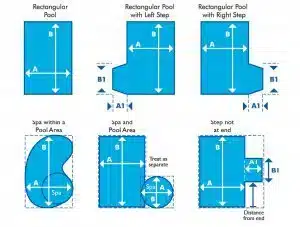
What exactly is meant by the term “step section”?
Each Daisy pool cover is tailor-made and welded in rectangular shapes. If a part of the pool extends beyond the main area, such as the steps, we can add welded rectangular sections to cover these areas. The term “step section” refers to the part of the pool cover that is welded along the side to accommodate these extensions.
What if I have a swim-out instead of a step section?
Regardless of whether the protruding section is a swim area, spa, or any other feature, it is still considered a ‘step area’ for all pool covers. We prefer to keep things straightforward!
What distinguishes a left step area from a right step area?
A step section is usually positioned near one of the corners. When standing at the end of the step section and facing the pool, the step area will typically be either on your left or right. If it’s closer to your right foot, it’s referred to as a Right-Hand step area; if it’s on the left, it’s called a Left-Hand step area.
Does the location of my step section matter?
As long as we can identify the location of the ‘step area,’ we can weld an extra rectangular section to the main pool cover.
What if I have multiple step sections?
If there are multiple step areas, for example, steps on the right side and a protruding spa at the opposite end of the pool also on the right, we would refer to this setup as a Right-Hand step area with a Right-Hand Top step area.
What is the most accurate way to measure for a pool cover?
When measuring a step section, keep in mind that we create pool covers in rectangular shapes. Therefore, we need the length and width of the main pool area, as well as the dimensions of the step section. These two rectangles are then welded together to form a single cover.
Additionally, it’s important to specify the location of the step area(s), such as whether they are on the left or right, or at the end of the pool or another position. If the step area is at the end, we’ll need to know the distance from the end of the pool cover.
What if my pool has a unique shape?
Don’t worry if your pool has a unique shape, even with plenty of curves! All we need is the maximum length and width of your pool, and we’ll provide a rectangular cover that can be adjusted on-site.
When measuring a step area, keep in mind that it will be integrated with the main pool cover. If the step area extends beyond the main pool body, simply measure its length and width.
If the step area is recessed and doesn’t extend past the main body of the pool, no additional material is needed to cover it. You’ll just need to trim off any excess.
Why are pool covers from Daisy typically rectangular?
We provide our pool covers pre-trimmed and welded into rectangular shapes, giving you a nearly complete cover. Simply make the final adjustments on-site, using your pool as a precise template. This approach reduces the chances of measurement discrepancies, helping to minimize errors and material waste. Plus, if you need a quality pair of scissors for the job, we’ve got you covered!
Do you include coverage for a step section?
In most cases, the answer is yes.
However, if the step section is difficult to access each time you roll up the cover, it may be best to leave it uncovered. Similarly, if there is a centrally located step, such as a built-in seating area along a wall that is hard to reach, leaving it uncovered can make handling the pool cover more convenient.
How do I calculate the cost of a step section?
Pricing a step section follows the same method as pricing a pool cover. Measure the length and width to determine the total square meters, then add the step section’s square meters to the main pool area. Multiply the combined total by the cover price to calculate the cost.
Cost-Saving Tip: Instead of using the pool’s widest measurement (including the step section) as the total width, calculate the step separately. This prevents unnecessary material waste and ensures customers only pay for what they need.
How do I roll up a pool cover with a step section?
Step sections are typically positioned at the shallow end, while rollers are usually placed at the deep end, away from the main entry and exit points of the pool.
To roll up the pool cover, first fold the step section onto itself. This ensures a clear, straight path to the roller. Once the step section is folded, proceed to roll up the cover as usual. Leaving the step section folded while it’s on the roller is perfectly fine.
What are the challenges of having a step section?
In some cases, the step section is positioned at the roller end, requiring it to be folded at the start of the roll. This can lead to an uneven roll and may cause it to shift to one side.
The size of the step section can also pose difficulties. Folding a section that exceeds 2–3 meters in length or more than 1 meter in width can be challenging.
While step sections can be welded to any size, handling and folding larger sections can be tricky.